
I do not own this photo. Source
In March of 2009, Mark Bittman wrote an article about fake chicken for The New York Times. Bittman proposed that we can tackle animal-suffering (on factory farms) in one of four ways: improving the animals' living conditions; reduce or eliminate the animals' consciousness before the killing; consume less of those animals and their products (eggs, milk, etc.) treated cruelly and replace them with the animal-product that had been treated humanely during its lifetime. The last option is to completely reduce all animal consumption and replace it with mock-meats. This five year-old article makes a case for "fake meats" as a guilt-free option to meat. Fast-forward to present day, The New York Times recently published an article, written by Stephanie Strom, in which we are informed of the strides fake meat industries have taken to get from producing meat substitutes that taste "good enough" to actually tasting good.

I do no own this photo. Source
Mark Bittman first approached eating fake meats with a bit of disdain. He writes:
"I like traditional meat substitutes, like tofu, bean burgers, vegetable cutlets and so on, but have been mostly repelled by unconvincing nuggets and hot dogs, which lack bite, chew, juiciness and flavor. I’m also annoyed by the cost: why pay more for fake meat than real meat, especially since the production process is faster, easier and involves no butchering?"
(read more here)
However, he took an investigative approach to the question of whether or not it was worth it to substitute meat with... substitute-meat and decided that it made economic sense given the longterm goals (of society, as a global community). His argument was convincing from a moral standpoint; consuming mock-meat would certainly make one feel less guilty, right? But on the aspect of taste, it wasn't all that convincing. On test-tasting the mock-meat he says, "The plant-based products were actually pretty good." But most consumers aren't looking for pretty good. You won't convince your dad, your friend, your co-worker to switch to a vegetarian diet by describing the meat alternatives as pretty good.
I do not own this photo. Source
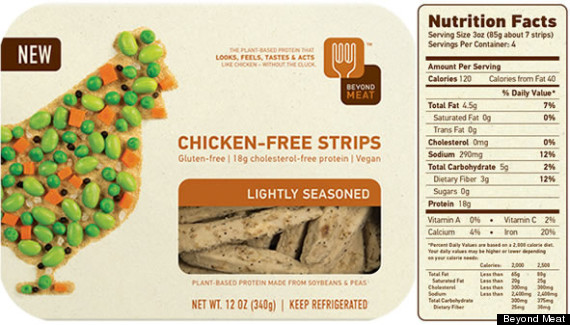
That's why the evolution of the taste of these fake-meats (the industry is still grappling for a better term to employ!) is so important. In Strom's article, As Ethan Brown, the founder of Beyond Meat, a producer of alternative meat products, is quoted saying in Strom's article:
" '[Fake meat] has to be just as good as, just as convenient as and maybe even cheaper than ground beef or chicken,” Mr. Brown said. “Our business is to create something better than meat; otherwise we are not going to move the needle.' ”
The economics:
And I am sure we can create this reality if more industries took an interest and found it worthwhile (ie. profitable) to join into the fake-meat industry. That would spur competition that could lead to developing better tasting fake-meat product that consumers would want to buy, lower the cost to the consumer and make it more widely available to all consumers. But for companies to even enter into this market we, as consumers interested in animal well-being despite the taste-differential, need to vote at the grocery store and show large companies that we are interested in these alternative products.
-Stacey Ladusch
